DIG: Discovering Fossils & Family
Transcript
So, these slides sat on my shelf for about a year, year and a half, in and out of carousels and projectors of varying degrees of functionality. The faded Kodachromes feature images of geologic charts, rock formations, bone fragments, and West Texas landscapes.
About a year before he died, my grandfather gave me three black metal boxes filled with his teaching slides. He was a professor of geology and paleontology at the University of Texas at Austin, and he used these in his teaching. I wasn’t sure why he gave them to me. I was interested in West Texas, interested in photography. I didn’t know what purpose it would have, but I knew they had some purpose, some power.
My grandfather, Dr. John A. Wilson, was a paleontologist who was particularly devoted to the West Texas landscape and Big Bend National Park, where rocks date as far back as 500 million years.
In 1949, he established the Vertebrate Paleontology Collection at the University of Texas at Austin. It’s a vast fossil repository and place for research, housing the university’s fossil collection.
He basically put it together. All the fossils in the university were scattered all over the campus. Now, they’re at the research lab, at the Pickle Campus on Research Boulevard.
Most of what I knew about my grandfather’s career came from his visits to Show and Tell in elementary school. He would bring an Albertosaurus skull or a mammoth tooth. Then, he’d have a measuring tape, and he’d measure out the 40-foot wingspan of the flying Pterosaur Quetzalcoatlus.
In 2008, many years later, he got pneumonia. I went to visit him in his hospital room. I brought this print of an ocotillo plant that I had taken, just to kind of liven up the place. When he saw the picture, he sat up really tall. He could identify the rock formation in the background, and its exact location within Big Bend National Park.
He was correct. I was standing directly across the street from Castolon Peak. At that moment, more than at any other time, I felt that the two of us were truly connected. He passed away a few hours later.
At the funeral service, I set up a slide projector. Some of his colleagues and former students kind of recognized themselves, in dusty jeans on paleontology digs. What I was noticing is that my grandfather had taken some of the exact same photographs of the same locations, but only, I would take them 50 years later.
This is Rio Grande from the Big Hill, between Presidio and Lajitas and Goat Mountain in Big Bend National Park.
So, with slides in hand, I decide to go back to the paleontology collection and reintroduce myself to my grandfather’s former colleagues. This is Dr. Wann Langston and Dr. Ernie Landelius. That day they told me a little bit about my grandfather. They talked about being a paleontologist. They pointed me to his greatest find.
One of the lab’s jewels is this skull called Rooneyia Viejaensis. As one of the most complete fossil primate skulls ever found in North America, it really was the find of a lifetime. Even the paper-thin bones of the nasal cavity were preserved, which is really extraordinary for a 43-million-year-old fossil. And even a half a century after its discovery, is the only specimen of Rooneyia that’s ever been found. So, it’s like a tree-dwelling primate. Think small.
Yeah. I had always regretted not going on a dig with my grandfather when he was alive. But about a month after my visit, I was invited to go on a paleontology dig in West Texas with some UT paleontologists. I’m always up for adventure, always up for photography. So I decided, “Yes.”
But, the paleontologist that I went with was following in my grandfather’s footsteps. He was actually using his field notes to find more primates like my grandfather did.
On that first dig, someone found a tapir jaw, someone found a rhino tooth, lots of 43-million-year-old rodent teeth, but no primates.
I brought my grandfather with me on that first dig. So, I was scattering his ashes there. It was the last moment to the last day of my first dig, and we got snowed out. If I had known at that moment that this wouldn’t be my last dig in West Texas, I might’ve saved some of those ashes for the most amazing landscapes to come. But, how could I have known? I can only hope that his ashes traveled on the winds and through the currents and the canyons to where they needed to settle.
I’ve been on 11 digs, I guess, now, every year. This is kind of what it feels like to look through the vast desert landscape for tiny, tiny teeth. You have to be hyper-present. It’s a meditative process. You have to be completely aware of your surroundings. I love it. It’s my favorite thing to do.
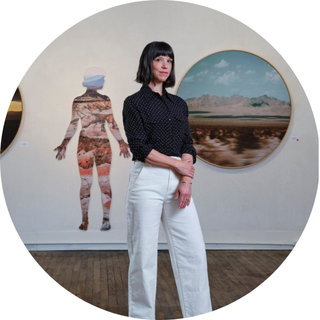
I’ve brought my grandfather’s slides with me to his localities out in West Texas and his 35-millimeter camera with expired film. Kind of, through his viewfinder, I see new connections to the landscape. I’m creating these three-dimensional works where I’m using wheat-pasted photographs on wood bases. This is in a gallery in Houston, right now. I’m also making work that deals with my connection to the landscape.
There’s a Latin term called cupio disolvi, which means, “I wish to be dissolved.” And, that’s how I feel when I’m out there. I almost want to sink into the desert landscape and just kind of become one with the eternal nature of those rocks.
So, this is me as a pregnant woman. I’m eight months pregnant. My head is on the left. My belly’s in the middle. My feet are on the right. I have incorporated myself into the Chisos mountain range, digitally.
I’ve spent so much time at the paleontology collection, now, that they gave me a title. I am the first and only Artist-in-Residence at the University of Texas Paleontology Collection. The title is a little bit less official than it sounds, but I do have access to the entire fossil record, to all the fossils my grandfather did back in the day.
So on my second dig, I found a jawbone with a couple of molars in it from an early deer-like mammal called Toxodon, a 43-million-year-old mammal. I realize, now, that finding such a specimen is rare. So much so, that my little jawbone has the honor of being displayed in its own tiny cardboard box in one of the wooden drawers at the lab. It has a locality number, the name of the species, Toxodon, the name of the collector, Sarah Wilson, on the label. It sits right next to my grandfather’s finds from 50 years before.
So I’ve been on digs for 11 years, and I still haven’t found a specimen of Rooneyia. I’m looking really hard.
It’s that adventure and it’s that search that really truly fulfills me. And I think, sometimes, about the other path, where I just left those slides on the shelf. I never brought them to my grandfather’s colleagues. You can never know, of course, what the other path is going to look like, but.
I do know that these slides have become a passport to an incredible adventure through deep time in the West Texas desert, and to knowing my grandfather and myself better than I ever did during his lifetime. So, thank you.