Tangled in the Wood Wide Web
Transcript
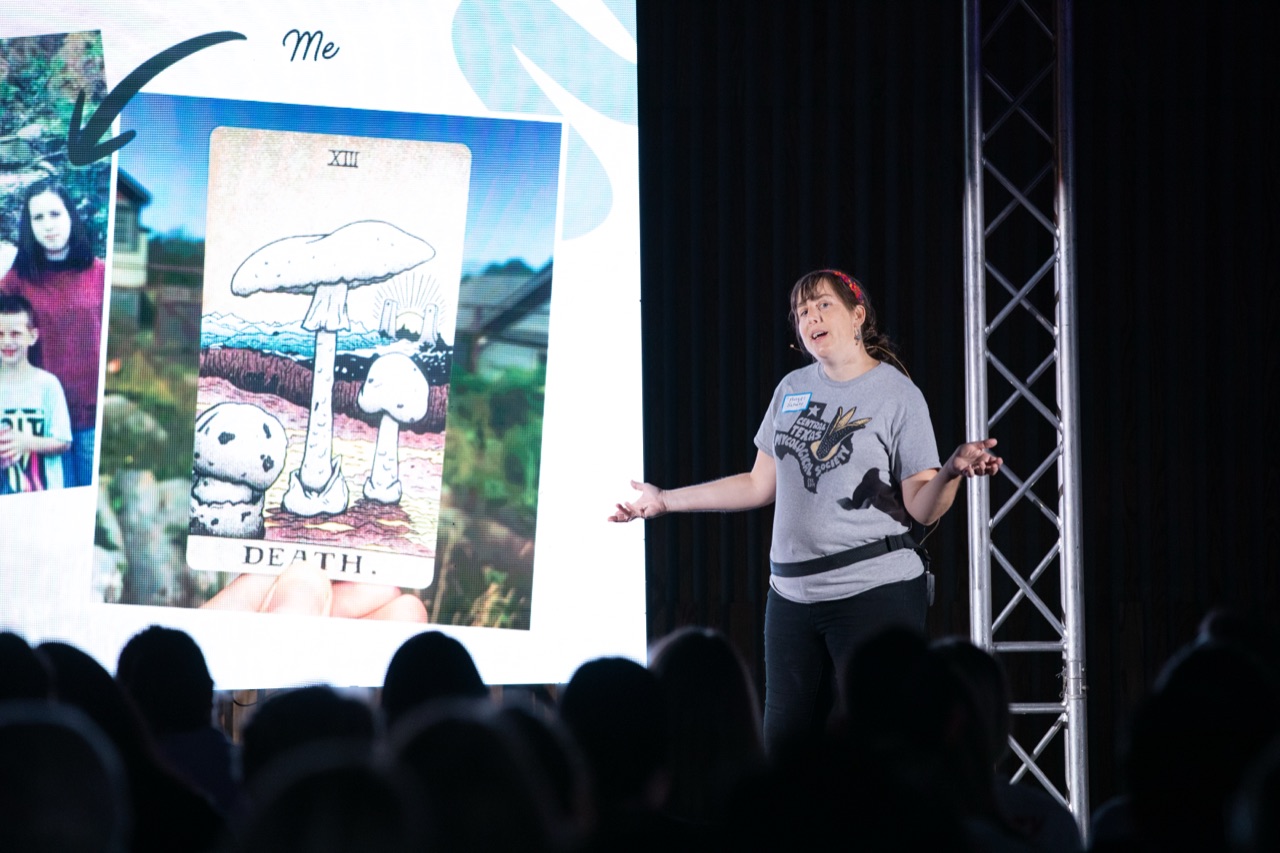
My name is Angel with the Central Texas Mycological Society, and I’m going to share how I got tangled up into the largest communication network on this planet: fungi. I grew up in the Midwest, and I had 10 siblings. We didn’t have a lot, but we did have the great outdoors. The first mushroom that I ever learned about was the destroying angel, and it came from a wildlife flashcard set from my grandma’s house. I was so fascinated. We shared a name. It was beautiful yet deadly, and that paradox stuck with me. I didn’t really know what it meant at the time, but I knew there was a story.
At the time, I also didn’t realize that fungi were everywhere. We would go out every spring and hunt for the choice edible mushroom, the morel. It was so delicious. It was hard to find. It was the first mushroom that I ever touched in my hands, and I didn’t know what was happening, but I knew that I wasn’t supposed to be afraid.
I moved to Texas after college, and I got tangled up in a lot of other things. I didn’t really think about mushrooms. I didn’t think they could grow here — it was still hot. I found other ways to get destroyed, in other words. But that changed in 2015, when I went to Mexico on a mushroom trip with mycologist Alan Rockefeller. In the misty cloud forests, we were finding mushrooms of every color — red, gold, blue even, and bioluminescent fungi. And I found the destroying angel for the first time in person, and I was wowed. I actually took my first melfie and changed my LinkedIn profile.
A few years later, there was a mushroom farm that opened up at Jester King Brewery, and I did a tour. They were growing mushrooms on spent coffee grounds and sawdust from a guitar shop up the street, and I was so wowed by this innovation. So when I found out that these were getting thrown in the trash after they grew mushrooms, I thought, there’s got to be another way. That’s around the time the Central Texas Mycological Society formed. We were just a few friends getting together, but now we’re a member-supported nonprofit with over 1,500 members from 17 states.
We divert thousands of pounds of this spent mushroom substrate, and we work with farms and we regenerate it — composted into soil — and it’s building community at the same time. It’s the equivalent of 160 cubic tons of carbon, which is about the same as planting 7,000 trees. There’s all kinds of studies that show that this isn’t waste — it’s actually great for our soils, especially here in Central Texas. They retain moisture, prevent erosion, grow more mushrooms in the garden. So we’ve had about 20,000 people sign up to use these blocks in their gardens — school, church, community gardens, farms, ranches.
One of the mushrooms that we really love to see here, which you might recognize from our logo, is called the devil’s cigar, or the Texas star. It’s one of the rarest mushrooms in the world. It actually became our state mushroom in 2021, but it’s rare because it’s only found here in Texas and Japan — we found it recently in Taiwan. Another thing that makes it rare is that it actually hisses when it releases its spores. I had to hear this, and I couldn’t find anything on the internet. So I collected some from the wild, and I even slept with them next to me on my bedside, thinking that I would wake up to the hissing sound. That didn’t happen. But I turned my bathroom into a studio, and I was the first person to capture this. So here’s some time lapse of them going from a cigar to a star. Every winter we take people out and find this mushroom next to cedar elm stumps, and we’re also working on getting a full genome sequence of it so we can better understand it.
Because some fungi are pathogenic — and that is what you’re seeing here. These are insects getting turned into zombies in Zilker Park, y’all. This stuff is happening below our feet if you look closely. We actually have a class coming up in a couple weeks. It’s called Cordy Splash. You may have heard of The Last of Us, the TV show — this is the science fiction of the TV show, but we’re going to tell you the real story.
Nothing can compare to the moment that I found the destroying angel in Texas. I was in the Lost Pines, and I finally found this mushroom that was on this flashcard set from my grandma’s house, and I realized that fungi are my secret ally. They are quietly helping — regenerating the soil, creating communities, and helping us in so many ways. So I hope you can myceliate with us as well in the wood wide web.