Running Against All Odds
Transcript
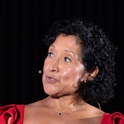
I did not grow up playing sports. However, 27 years ago, while standing at the finish line of the Bank of America Chicago Marathon as a spectator, something incredible happened. As I watched the runners cross the finish line, I noticed that there were big, small, short, tall, every race, and every ethnicity. And something said to me, “Wow, if they can do it, so can I.” So the next day, I decided, I’m going to try this. I started fast walking in my neighborhood. Eventually, my fast walking became jogging, and eventually I was able to run one mile without losing my breath. That was very inspiring, and I decided to run my first 5K. I figured I may be the last runner, but that’s okay — I want to try this. To my surprise, I was not the last runner. There were a lot of people behind me. And that moment gave me so much courage, so much motivation, that I never looked back.
I then ran a half marathon, and then eventually I ran my first marathon at the age of 38. It just became a passion, and it became my second family. I later paced for the Chicago Marathon. Pacing is those runners you see with the little sign — they help runners get to the finish line, to help them reach their goal. I did that for 15 years in a row. I was addicted. It became just a lifestyle. Then I moved to Austin 16 years ago, and in Austin, I found an amazing running community. Not like the crazy stuff going on now — it was big back 16 years ago; now it’s insane. I later joined the Rogue Running club, and they became my second family. I made friends, and it just became a community.
However, in 2013, my life came to a screeching halt when I fell in my home, busted my head open, and had to be rushed to the ER. At the ER, the doctor says, “Sara, you’re going to be fine, but you should go see a neurosurgeon, because you have a brain tumor.” I’m like, “What? What is he talking about? There’s got to be a mistake. I feel fine.” I didn’t have any symptoms. I was running two to three marathons a year. But the reality set in, and I went to see a neurosurgeon, and he confirmed that the type of tumor that I had grows very slowly, and that I’d probably had it for 20 years with no symptoms. So that was very shocking. I consulted with my family, and we decided to have surgery in June of 2015.
The tumor was removed, and I went home to recover. However, as a result of the surgery, I was left with — it’s called a drop foot, which means you have no dorsiflexion. So I had to walk dragging my foot. I needed assistance. I was not able to walk. And as a very active person, obviously, I was devastated. The recovery was very challenging. I felt very isolated. I was at home recovering, and the running community and my family were very supportive. The one ask I had of my friends visiting is, can you please come and walk with me? Because walking for 15 minutes a day was part of my recovery. And when I didn’t have anyone to walk with me, I trained my 60-pound dog to drag me down the street. And that’s how I was able to get my walking in.
At my follow-up appointment, I asked my doctor, Dr. Zhu, when can I run another marathon? He kind of laughed, and he said, “Sara, most of my patients just want to be able to walk again. You want to run a marathon?” I said, “Yes.” Now, mind you, I couldn’t walk. But he said, “Well, you’re not going to hurt anything. Your tumor came back as benign.” So that was a blessing — I was very grateful for that. But the recovery was the same. He gave me his blessing, and that’s all I needed to hear. I started training harder, going out for more walks. Eventually, I was able to walk unassisted, and eventually I started jogging — trotting, rather — eventually jogging. And seven months after my brain surgery, I was able to not only run, but I paced the Houston Marathon. It was a very bold goal, but I figured, hey, if I could run it, I might as well help others. So I paced the marathon, and then I went on to run my first 50-kilometer trail race. I was extremely grateful that I had this second opportunity to do something I’m very passionate about.
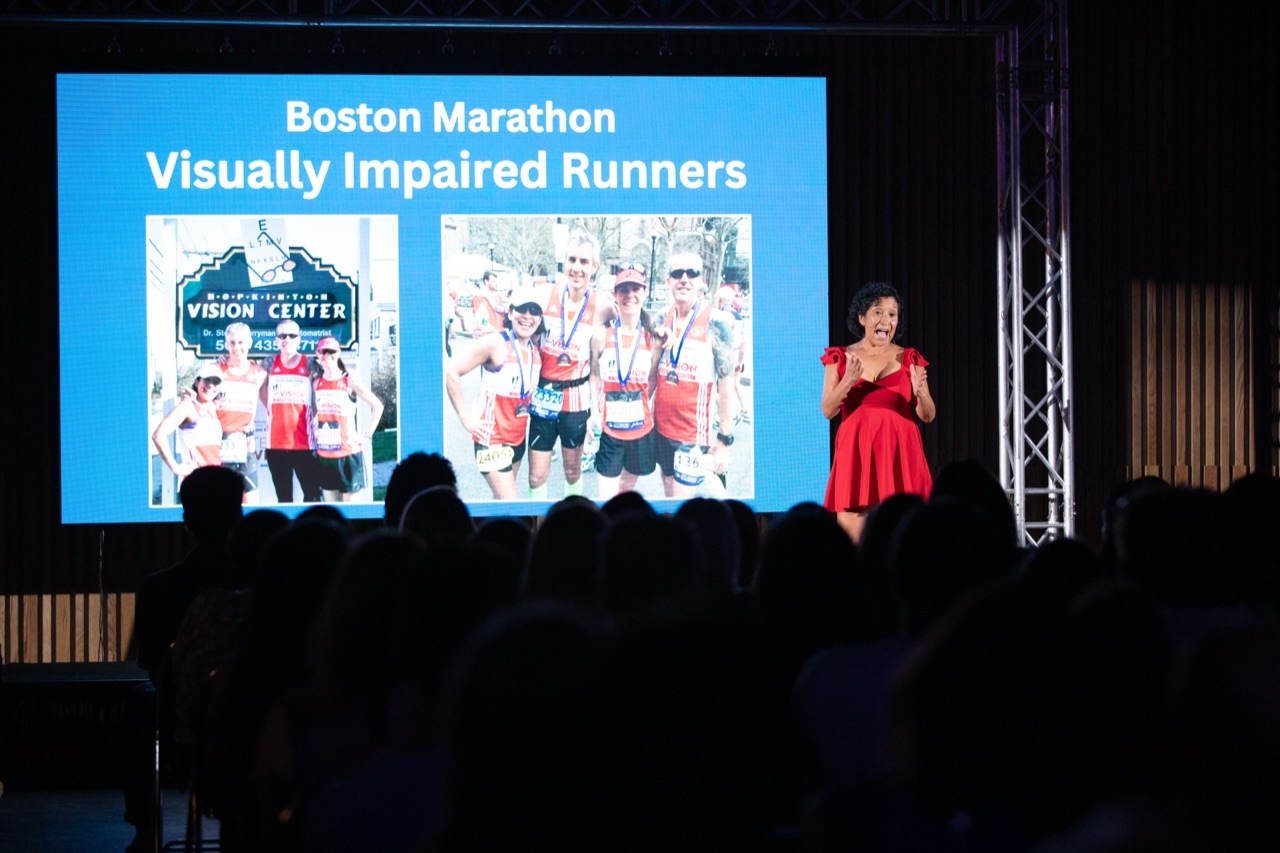
One of the most memorable pacing experiences I had was pacing a blind runner during the Boston Marathon. This gentleman came from Canada, and I was his eyes and his support during the marathon. That gave me so much satisfaction, because every step we took just demonstrated the human spirit. He was so grateful to have people like me volunteer to help blind runners cross the finish line, and that is one of my most memorable pacing experiences. Giving back to the community has been something I’m very grateful for.
So, as if that wasn’t challenging enough, after my brain surgery I decided to set a very big goal for myself, and that is to run the Abbott World Marathon Majors. That consists of six of the top prestigious marathons in the world, which is Chicago, New York, Boston, London, Berlin, and Tokyo. And this past March, I had the honor to cross the finish line at the Tokyo Marathon, completing the majors. It was my 59th marathon, at 62 years old. And I hope that by sharing my story, I inspire others not to give up. There is so much help out there — just seek it out. Don’t be afraid. Don’t take no for an answer. And with dedication and perseverance, you can accomplish anything you set your mind to do. Thank you so much.