The Ice Age Animals of Central Texas
Transcript
This is Central Texas. Central Texas, over 12,000 years ago, during the Ice Age. I’m a paleontologist that studies the Ice Age, and I want to know about all of these creatures. I want to know all about the camels, the ground sloths, the mammoths, the saber-toothed cats, and all the rest. What were they like? How did they interact? What did they eat? And most importantly, what happened to them? Why don’t we have mammoths and saber-toothed cats today? Why do we have roadrunners, raccoons, and rattlesnakes? What historical events set the stage for nature as we know it?
Ice Age fossils can help us answer those questions. They can shed light on our past, inform our present, and help us think about what could happen in the future. And here in Central Texas, the best place to study the Ice Age is actually inside caves. Paleontologists, like many of my predecessors, have spent over a century climbing and crawling through caves across Central Texas in search of Ice Age fossils. Yet despite all of that work, we still are missing key pieces of the puzzle we need to understand Ice Age extinction.
So when I moved here in 2019, I started doing the same thing, delving into caves for clues about our past. And along the way, I met other cavers. They showed me the ropes, helped me find fossils, and became my friends. One of those people was John Young, my good friend here on the right.
Back in the summer of 2022, John was exploring a cave called Bender’s Cave, and he started sending me photos of fossils he was seeing there. Just one or two photos at first. Then a few more. Then some more. Then a lot more, then this barrage of texts every day. So finally, I said, “John, quit it. I’ll bite. When do you want to go see the cave?”
We set a date. We’re going to go out on a Saturday. Friday night rolls around, and I’m texting John. “Hey, we’re still good for tomorrow, right?” “Oh, yeah. Excited. Hey, but just don’t forget. Don’t forget your wetsuit, your snorkel, and your dive mask.” I thought that was kind of weird, so I texted back, “LOL.” And he texted back, “No, no, no, really. Seriously. This cave has an underground river in it. It’s partially filled with water. The water is chilly. Yeah, we need a wetsuit. And the fossils, well, they’re underwater. So to find them, we need a dive mask and a snorkel.”
This is all news to me. So I text back something like, “Hey, what the heck, man? You didn’t tell me any of this. I’ve never been in a cave like this. I don’t have most of this stuff.” We pushed the trip back a day. I got on Amazon. Everything’s coming to my house by Saturday night. And here we are, Sunday morning, at the entrance to Bender’s Cave, preparing to go in.
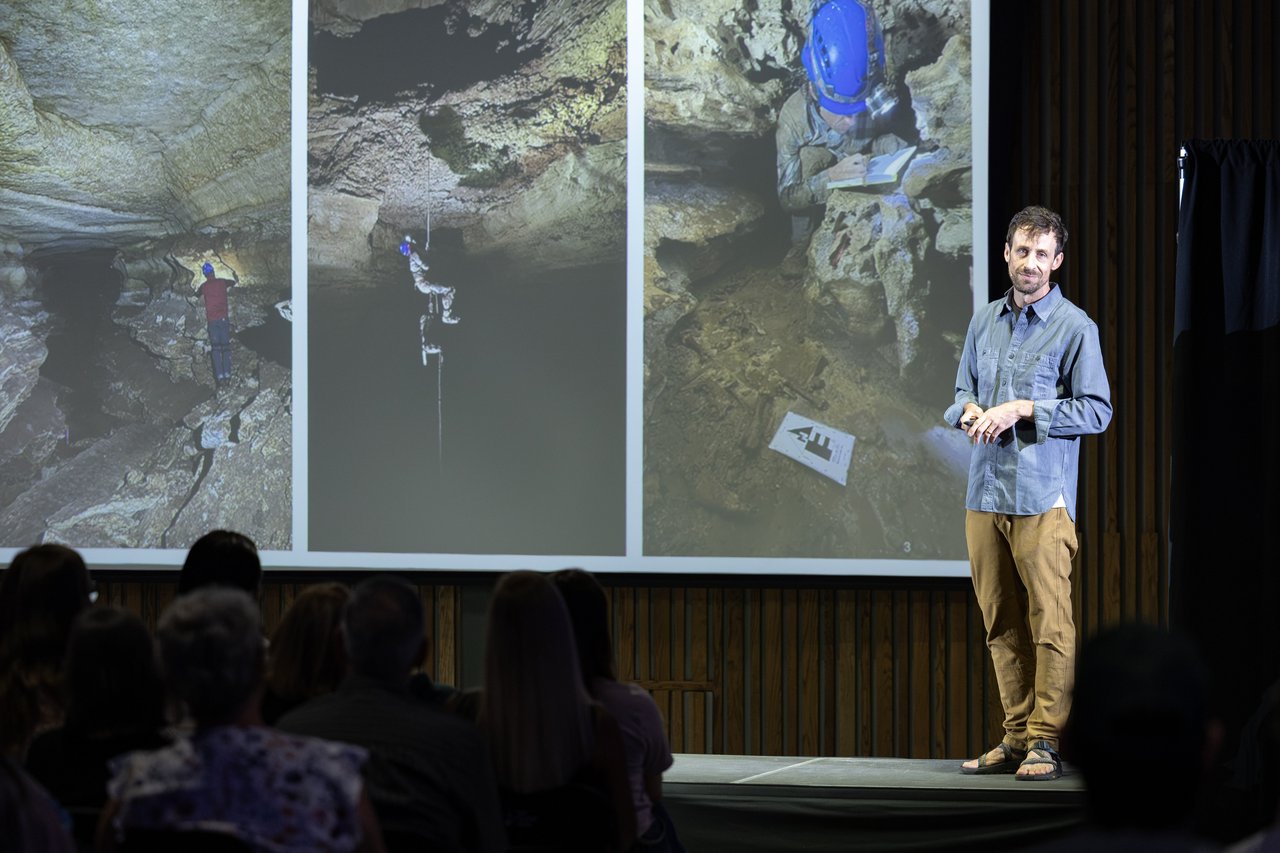
First, we don our wetsuits, knee pads, elbow pads, helmets, lights, backpacks full of stuff. And, of course, these harnesses. We need these harnesses. They’re going to allow us to rappel 40 feet straight down into the earth. That’s how we enter Bender’s Cave. We tie a rope around a tree, then around some bolts in bedrock, attach ourselves to the rope, and we slide down. It’s tight at first, but as we descend over 40 feet, the shaft we’re in becomes wider.
We hit the bottom. We shed our harnesses. We crawl for 30 yards or more until we find a crevice, a small hole in the floor, and we squeeze through there. And all of a sudden, just like that, we’re in water. Open, flowing, clear water. Flowing water moving through the horizontal, tunnel-like passages of Bender’s Cave as an underground river. John slaps on his mask, his snorkel, and he’s off swimming ahead away from me, looking for underwater fossils. He’s used to this. I’m not. And I need a few more minutes to get my bearings here.
This place is strange. It’s unusual, even for somebody that’s grown accustomed to caves. And actually, these photos are nice, but they don’t fully convey what it’s like to be there. Maybe I have something a little bit more, a different photo, something more visceral. Yeah, this. This is more what it’s like. It is dark. Beyond anything else, it’s dark in there. It’s cold, too. This is groundwater. It’s spring water, just like what’s in Barton Springs. Same temperature, too: 67, 68 degrees. And here, we don’t have the sun to warm us back up. Immersed in the water for hours as we swim along, I am shivering.
But it’s all worth it, because as we move through the cave, we’re plucking up from the underwater stream bed bones and teeth of Ice Age animals. Bones and teeth of camels. Bones and teeth of saber-toothed cats. Bones and teeth of mammoths, giant bison, horses, dire wolves, deer, turtles, you name it. And for the most part, these are the animals we would expect from the Ice Age in Texas.
But after nine trips to collect hundreds of individual fossils, we realize the cave is showing us something else, too. We’re encountering a rare and unusual set of animals. Rare animals that include Jefferson’s ground sloth, a giant sloth five to six feet tall at the shoulder. Mastodons, elephant-like animals that browsed on trees. Even giant tortoises. Think about Galápagos tortoises here. Huge, lumbering land creatures with shells three to four feet in diameter. Another shelled animal, too, actually. This is a pampathere, distant relatives of armadillos, and physically pretty similar, but these animals were six to eight feet long. That’s a big armadillo.
And these fossils and the animals they represent, they really are exciting. They really are rare. As we step back and look at the Edwards Plateau of Central Texas, there are 20 other Ice Age sites here. That’s a lot. And Jefferson’s ground sloth, mastodon, they’ve been found in only one or two of these. Pampathere and giant tortoises, they’ve never been found here at all. And in fact, my predecessors published statements saying that these two creatures never existed in Central Texas. Period. But we’re finding their teeth, we’re finding their bones. These animals were here.
What’s going on? What does this all really mean? Well, our data suggests that this sloth claw and other fossils from Bender’s Cave are showing us an animal community from a portion of time, a time period within the Ice Age, that we’ve never before discovered here in Central Texas. And just as the past informs our present, older portions of the Ice Age help us better understand the extinctions that happened at the end of the Ice Age. And that means Bender’s Cave is one of these key missing pieces of the Ice Age puzzle. We need to understand the extinction of the mammoth and the saber-toothed cat and the rise of the raccoon, the rattlesnake, and the rest of the living animal community.